Download Cisco Certified Support Technician (CCST) Cybersecurity.100-160.Actual4Test.2026-11-10.226q.vcex
| Vendor: | Cisco |
| Exam Code: | 100-160 |
| Exam Name: | Cisco Certified Support Technician (CCST) Cybersecurity |
| Date: | Nov 10, 2026 |
| File Size: | 606 KB |
How to open VCEX files?
Files with VCEX extension can be opened by ProfExam Simulator.
Discount: 20%

Demo Questions
Question 1
Which of the following practices help in preserving the physical integrity of digital evidence?
- Storing the evidence in a cold, damp environment.
- Cleaning the evidence using chemical solvents.
- Using non-conductive gloves when handling the evidence.
- Leaving the evidence exposed to natural light.
Correct answer: C
Explanation:
Preserving the physical integrity of digital evidence is essential to prevent contamination or damage. Using non-conductive gloves is one such practice as it prevents the transfer of oils, dirt, or other substances that could potentially damage or alter the evidence. This helps to maintain the integrity of the evidence and ensures that any potential traces or fingerprints left on the evidence are not compromised.
Question 2
What is the primary reason for implementing multi-factor authentication in a cloud environment?
- To provide an additional layer of security
- To simplify the authentication process
- To reduce costs
- To improve performance
Correct answer: A
Explanation:
Option 1: Correct. Implementing multi-factor authentication provides an additional layer of security by requiring users to provide multiple forms of authentication to access cloud resources.Option 2: Incorrect. The primary reason for implementing multi-factor authentication is to provide an additional layer of security, not to simplify the authentication process.Option 3: Incorrect. The primary reason for implementing multi-factor authentication is to provide an additional layer of security, not to reduce costs.Option 4: Incorrect. The primary reason for implementing multi-factor authentication is to provide an additional layer of security, not to improve performance.
Question 3
Which of the following activities is typically associated with reconnaissance in cybersecurity?
- Preventing unauthorized access
- Exploiting vulnerabilities
- Gathering information about the target network
- Identifying vulnerable systems
Correct answer: C
Explanation:
Reconnaissance in cybersecurity involves gathering information about the target network, such as IP addresses, open ports, and potential vulnerabilities. This information is used to prepare for a potential attack by understanding the target's infrastructure and weaknesses.
Question 4
What is the purpose of a firewall in endpoint security?
- Monitor and detect suspicious activities on the endpoint
- Encrypt the data transmitted between the endpoint and the network
- Protect the endpoint from malware
- Prevent unauthorized access to the endpoint
Correct answer: D
Explanation:
Firewalls are a key component of endpoint security as they help prevent unauthorized access to the endpoint. Firewalls work by examining incoming and outgoing network traffic and applying a set of rules to allow or block specific connections. By filtering and monitoring network traffic, firewalls act as a barrier between the endpoint and potential threats, such as hackers or unauthorized users, ensuring only authorized and secure connections are established.
Question 5
What is a common outcome of a vulnerability assessment?
- Confirmation that the system is completely secure.
- A detailed report on the system's security posture.
- A list of all vulnerabilities found in the system.
- Remediation steps to fix identified vulnerabilities.
Correct answer: B
Explanation:
A common outcome of a vulnerability assessment is a detailed report that provides an overview of the system's security posture. This report may include information about vulnerabilities, their severity, recommendations for remediation, and overall risk assessment.
Question 6
Which network security technology passively monitors network traffic and compares the captured packet stream with known malicious signatures?
- IDS
- IPS
- Proxy Server
- Honeypot
Correct answer: A
Explanation:
The CCST Cybersecurity course states that an Intrusion Detection System (IDS) passively monitors network or system traffic and analyzes it against a database of known threat signatures or behavioral patterns."IDS devices inspect network traffic, compare it to known malicious signatures or anomalies, and generate alerts for suspicious activity without actively blocking traffic." (CCST Cybersecurity, Basic Network Security Concepts, IDS and IPS section, Cisco Networking Academy) A is correct: IDS is passive and signature-based.B (IPS) is active and can block traffic.C (Proxy Server) handles requests between clients and servers.D (Honeypot) is a decoy system to attract attackers.
Question 7
Which protocol is used for broadcasting and resolving MAC addresses to IP addresses?
- ICMP
- TCP
- ARP
- UDP
Correct answer: C
Explanation:
ARP (Address Resolution Protocol) is used for broadcasting and resolving MAC (Media Access Control) addresses to IP addresses within a local network. It helps devices determine the MAC address associated with a given IP address, enabling proper communication on the network. ARP operates at the data link layer of the OSI model.
Question 8
Which of the following updates is responsible for ensuring proper communication between hardware devices and the operating system?
- Device drivers
- Windows Update
- Application updates
- Firmware updates
Correct answer: A
Explanation:
Device drivers are software programs that facilitate communication between hardware devices (such as printers, graphics cards, or network adapters) and the operating system. Updating device drivers is important as it can enhance compatibility, performance, and resolve known issues or security vulnerabilities.
Question 9
During the incident handling process, what is the main purpose of conducting a post-incident analysis?
- Assessing the overall effectiveness of the incident response plan
- Providing management with a summary of the incident
- Restoring all affected systems to their pre-incident state
- Identifying the individuals responsible for the incident
Correct answer: A
Explanation:
Conducting a post-incident analysis serves the purpose of assessing the overall effectiveness of the incident response plan. It helps identify any weaknesses or areas for improvement in the plan. While identifying responsible individuals, restoring affected systems, and providing management summaries are important aspects, the primary focus of a post-incident analysis is to evaluate and enhance future incident response efforts.
Question 10
What is privilege escalation in the context of cybersecurity?
- The act of elevating one's user account privileges to gain higher levels of access
- The technique used to bypass firewall protections
- The process of gaining unauthorized access to a system
- The method of stealing sensitive information from a compromised system
Correct answer: A
Explanation:
Privilege escalation refers to the process of gaining higher levels of access or permissions than originally authorized. This can be achieved by exploiting vulnerabilities or weaknesses in a system, such as a software flaw or misconfiguration. By escalating privileges, an attacker can gain more control and access to sensitive data or critical system resources. It is a serious security concern and is commonly used by attackers to broaden their scope of unauthorized activities within a compromised system or network. Implementing strong access controls and regular security updates can help mitigate the risk of privilege escalation.
HOW TO OPEN VCE FILES
Use VCE Exam Simulator to open VCE files
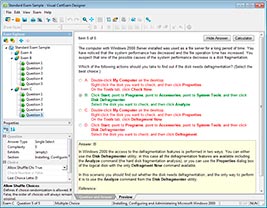
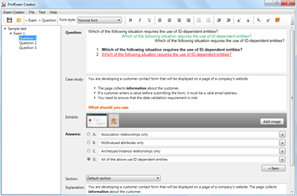
HOW TO OPEN VCEX AND EXAM FILES
Use ProfExam Simulator to open VCEX and EXAM files

ProfExam at a 20% markdown
You have the opportunity to purchase ProfExam at a 20% reduced price
Get Now!